Posture-Related Neck Stiffness
Forward head posture can increase stress on deep neck muscles, joints, and connective tissue.


 Book Your $49 First Experience
Clinic information, patient education, and online scheduling for 100% Chiropractic Austin Rosedale on MendAndFlow.
100% Chiropractic Austin Rosedale 3800 N Lamar Blvd, Ste 160 Austin, TX 78756 (512) 638-8544Headaches and neck tension in Austin, TX
Recurring tension headaches, neck stiffness, and posture-related discomfort can build gradually from modern work, stress, and daily movement habits.
Temporary relief can help you feel better for a short time, but recurring headaches and neck pain often require a closer look at posture, mobility, muscle guarding, and how your body is adapting to daily stress. Many people do not realize how much recurring headaches and neck tension are affecting focus, sleep, workouts, stress levels, and daily movement until the pattern becomes difficult to ignore. Our goal is to help identify why symptoms keep returning - not just where they hurt.
Same-day and same-week appointments are often available.
Why this happens
When your neck and upper spine stay under constant strain, your body adapts in ways that can lead to tension, stiffness, and recurring headaches.
For many Austin professionals and hybrid workers, parents, and active Austin adults who want to keep moving, headaches and neck pain are not one-time problems - they become recurring patterns that affect focus, sleep, workouts, and daily life.
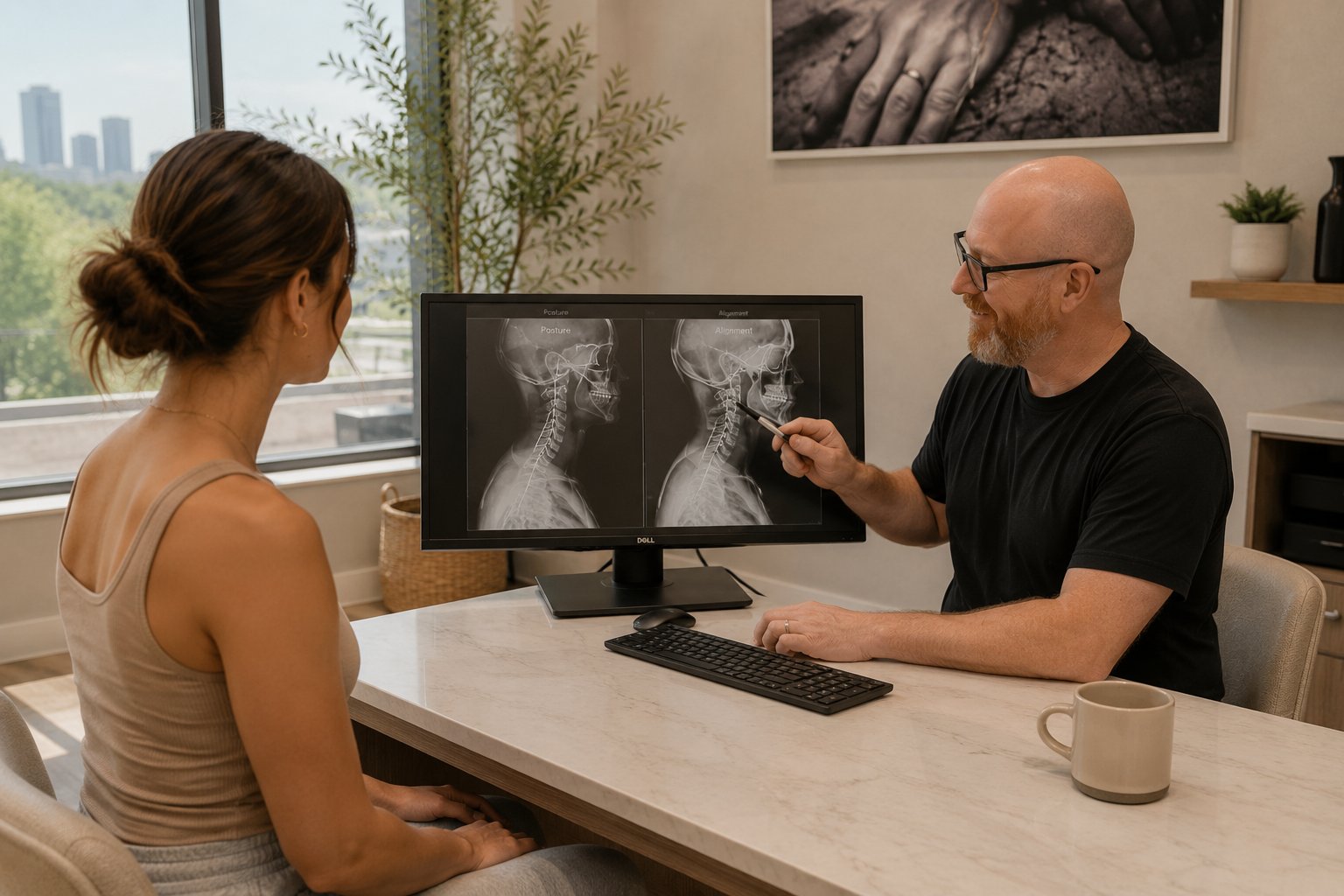
Forward head posture can increase stress on deep neck muscles, joints, and connective tissue.
Limited neck and upper back motion can create stiffness and compensation patterns.
Neck pain and headaches are often connected to posture, joint mobility, muscle guarding, stress load, and daily movement habits.
Even small shifts forward can increase stress on your spine, muscles, and joints.
0" forward shift
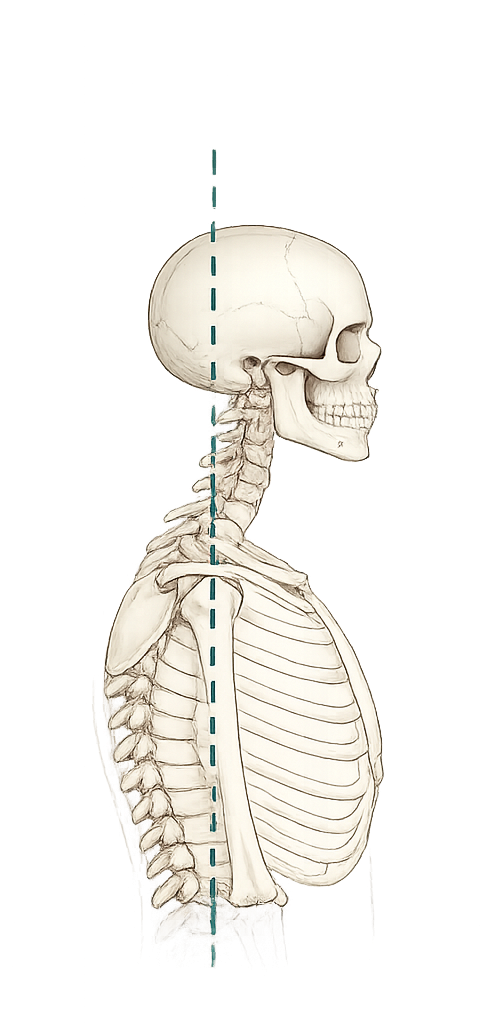
 Balanced alignment reduces stress on the spine.
 Muscles can work efficiently.
 Less strain, more freedom of movement.
2.5" forward shift
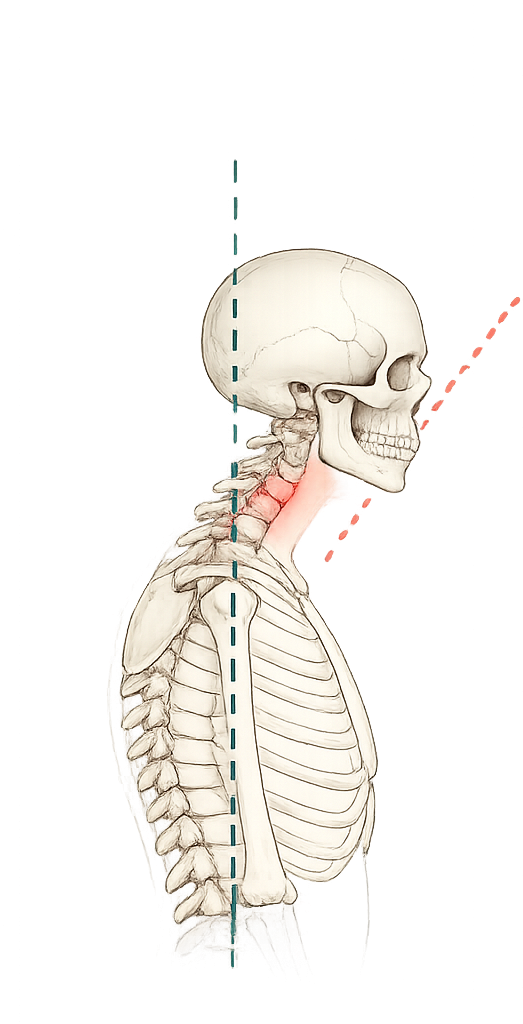
 Neck experiences up to 27 lbs of extra force.
 Muscles overwork to hold your head up.
 Commonly linked to tension, fatigue, and headaches.
4" forward shift
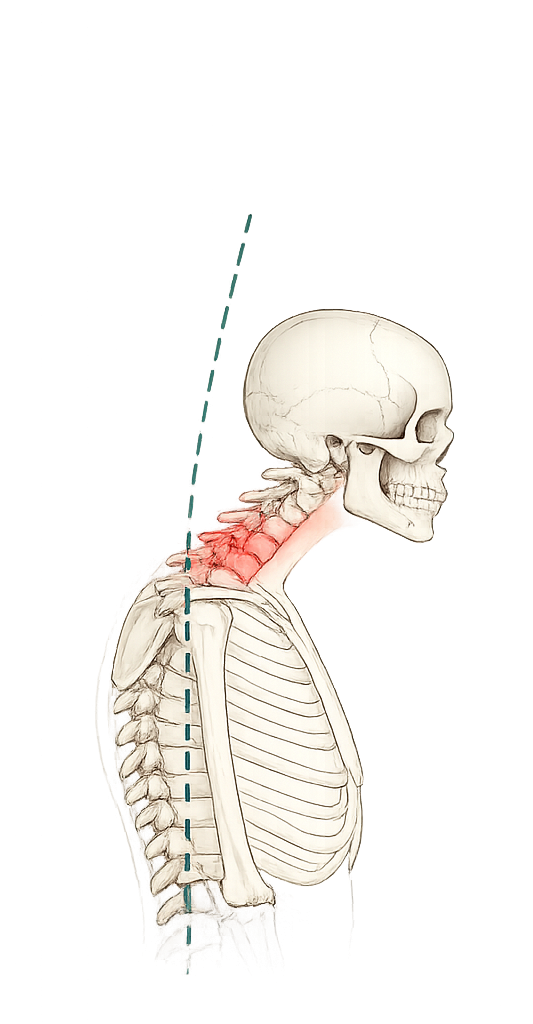 Neck experiences up to 60 lbs of extra force.Higher risk of recurring pain and stiffness.
 Can affect posture, mobility, and quality of life.
 Small changes in head position can create big changes in how you feel.
 Prolonged screen time
 Looking down at devices
 Poor workstation setup
 Muscle imbalance
 Stress patterns
 The good news? With awareness and the right supportive approach, posture can improve.
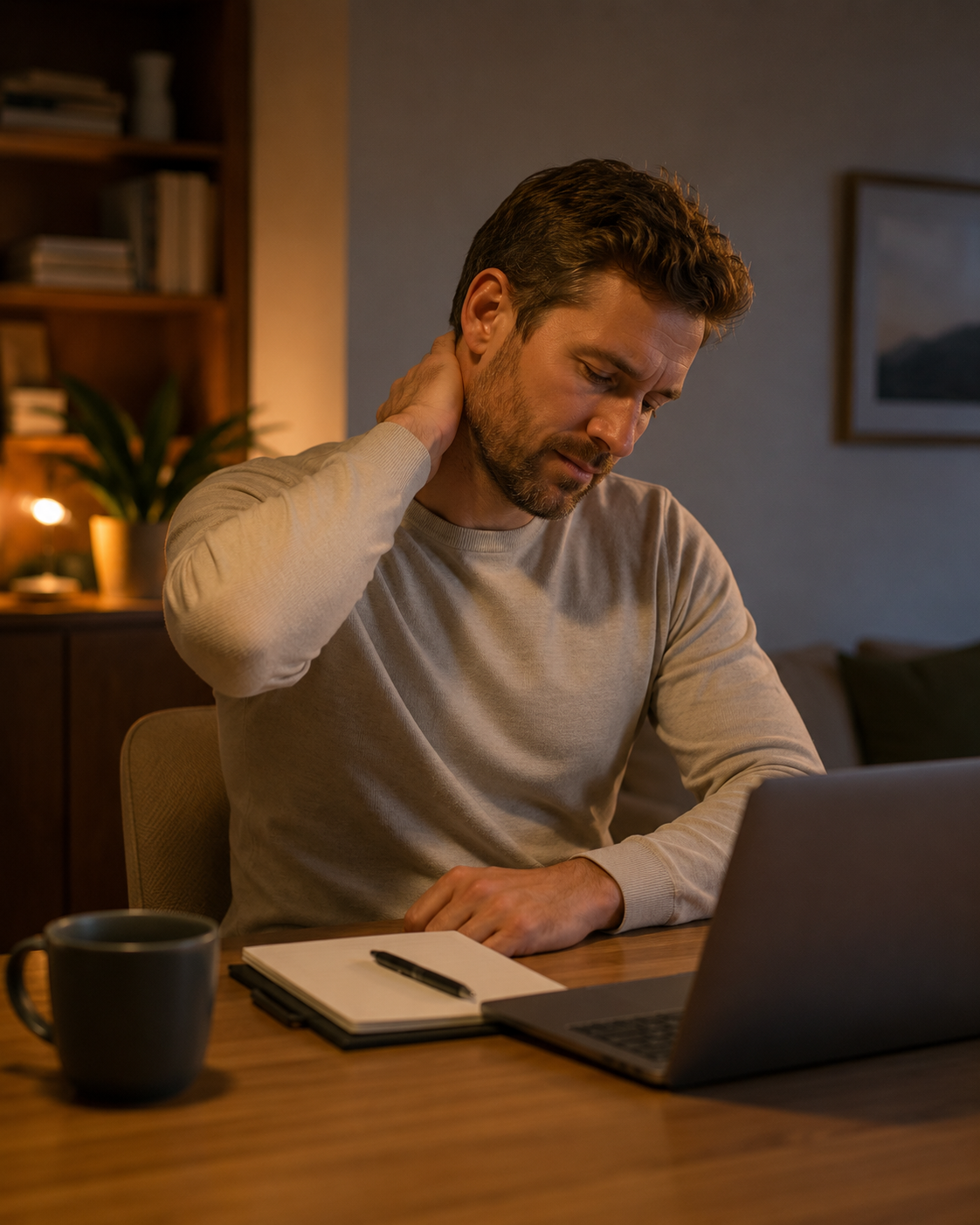
Common symptoms
Why temporary relief often does not last
Temporary relief can feel encouraging, but many people become frustrated when symptoms repeatedly return because the underlying movement, posture, and tension patterns were never fully addressed.
Temporary relief alone often does not change the movement patterns contributing to recurring tension. In our clinic, we focus on why symptoms keep returning - not just where they hurt.
This is part of why our clinic focuses on a more corrective-care-oriented approach rather than only temporary relief.
 Often focuses on chasing symptoms like tightness or pain when they flare up.
 May include quick adjustments or repeated stretching.
 Helpful short term, but recurring patterns usually return when stress, posture, and movement habits repeat.
 Evaluates patterns such as posture, mobility limitation, and muscle guarding.
 Aims to provide supportive strategies that reinforce how you move.
 Helps patients better understand factors contributing to recurring neck tension patterns.
What patients often notice
Many people do not seek care the first time their neck feels tight or a headache appears. They usually come in after they start noticing a pattern.
A clear explanation first
Our evaluations look at mobility, posture, muscle guarding, daily work habits, and musculoskeletal stress for Central Austin and Rosedale patients. The goal is to understand why the pattern keeps repeating before recommending care.
Your first visit is designed to understand the pattern behind your symptoms - not just where it hurts that day. When clinically indicated, that may include posture and mobility evaluation, orthopedic findings, muscle guarding assessment, and digital X-rays.
Dr. Nicolas Kellerman helps patients understand how posture, mobility, muscle guarding, and daily movement habits may contribute to recurring neck pain and headaches.
Many people normalize headaches and neck tension for years before realizing how much it is affecting focus, sleep, posture, workouts, stress levels, and daily movement.
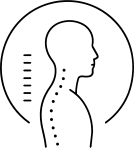
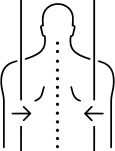
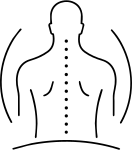
Our integrated approach
Our approach is designed to evaluate musculoskeletal contributors to recurring tension and help patients move, feel, and function better. Learn more about our corrective-care approach.
Our goal is not simply to help patients feel better temporarily. We aim to help them move better, function better, and better understand the patterns contributing to recurring tension.
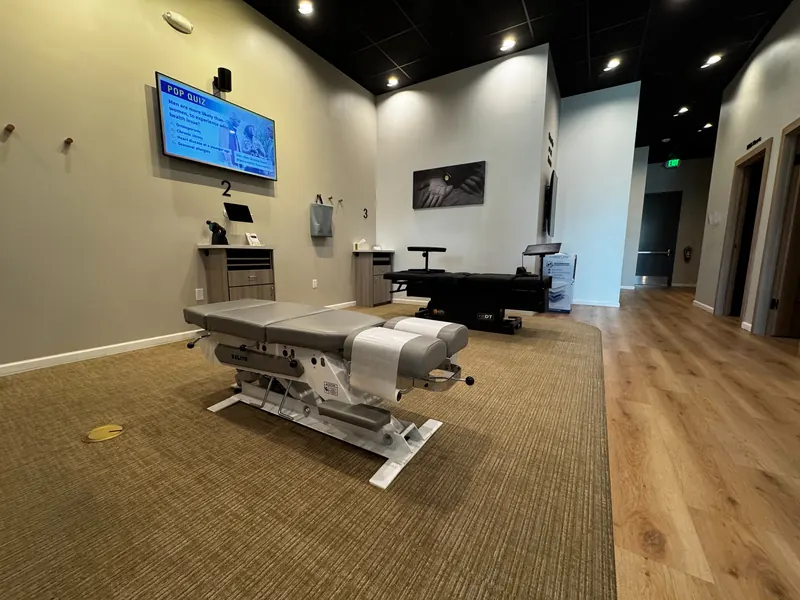
Supports joint motion and spinal mechanics to reduce stiffness, improve mobility, and help your body move with less compensation.
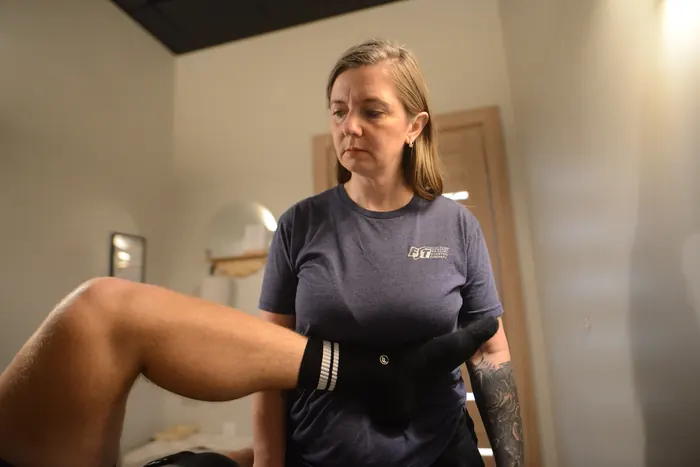
Targets tight connective tissue and muscle restrictions to improve flexibility, reduce tension, and restore more comfortable movement.
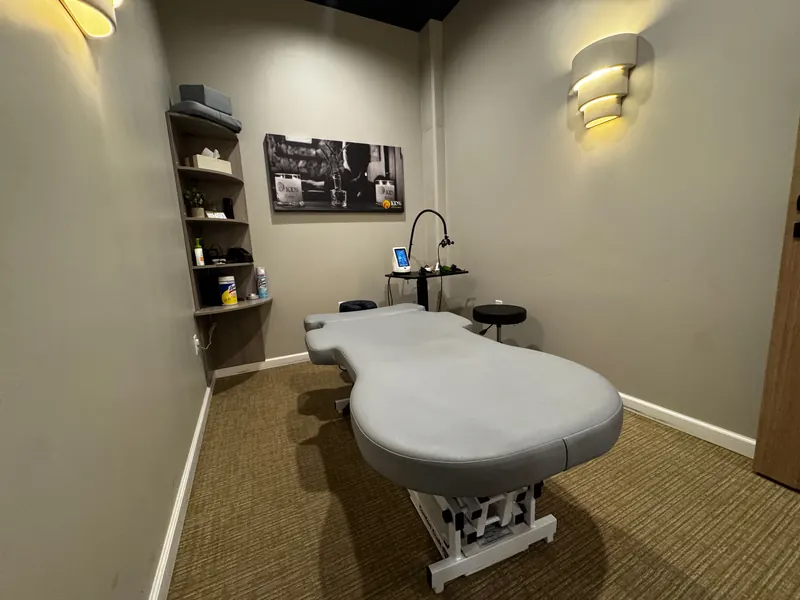
Supports irritated soft tissue, inflammatory modulation, and comfort when clinically appropriate for your care plan.
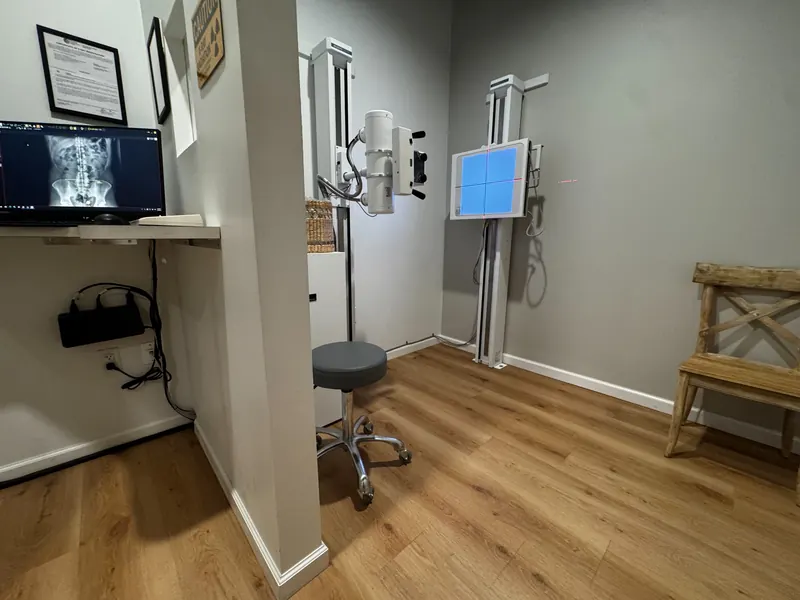
Builds better movement habits so progress in the clinic can translate into work, workouts, sleep, and daily life.
Why choose this clinic
Not every neck pain or headache visit should feel like a quick adjustment and goodbye. Our clinic is built around a more complete, movement-focused experience.
Many patients come to us after trying temporary relief strategies that never fully addressed the recurring pattern.
We believe recurring neck pain deserves a more thoughtful evaluation than a rushed five-minute visit, which is why our movement-focused corrective care emphasizes posture, mobility, and recurring patterns.
We look for patterns behind recurring symptoms, not just short-term relief.
Chiropractic care, posture evaluation, movement guidance, and supportive therapies when appropriate.
Designed to feel professional, warm, and approachable.
Patients work with a clinic director experienced in evaluating recurring neck pain, stiffness, and postural stress.
Patients leave understanding what may be contributing to their symptoms and what options may make sense.
Patient stories
Google rating source videos and educational content may help patients understand the clinic experience for recurring tension, stiffness, headaches, or mobility issues.
Reviews from patients across Google, Zocdoc, and other platforms.
How recurring tension from screen-heavy habits started becoming a pattern.
How daily headaches and posture strain started affecting work and focus.
A focused evaluation can help identify whether posture, mobility, muscle guarding, or movement habits may be contributing to recurring headaches or neck pain.
For many people, recurring neck pain and headaches are not caused by one single event. They often build from posture strain, reduced neck and upper back mobility, muscle guarding, stress load, repetitive desk positioning, and movement habits that accumulate over time. Temporary relief may help briefly, but recurring symptoms often require a closer look at the musculoskeletal patterns contributing to the cycle.
Yes. Tension in the neck, upper back, and base of the skull can contribute to headache patterns for some people. Our evaluation looks at musculoskeletal factors such as posture, mobility, muscle guarding, joint motion, and daily movement habits.
Yes. Forward head posture, prolonged desk positioning, and upper neck tension can increase stress on the muscles and joints surrounding the cervical spine. Over time, this often contributes to recurring tension headaches, stiffness, and reduced mobility for some individuals.
Long periods of sitting, screen use, and forward-head positioning can place ongoing stress on the neck and upper back. Many Austin professionals, hybrid workers, and remote workers notice symptoms worsen later in the day as muscle fatigue and tension accumulate.
Some people experience short-term relief from stretching or self-manipulation, but recurring tension often involves broader factors such as posture, movement habits, joint mobility, muscle guarding, and stress patterns. Our approach focuses on evaluating the bigger picture rather than only chasing temporary relief.
Migraine symptoms can be complex. We evaluate musculoskeletal factors that may contribute to neck tension, posture strain, reduced mobility, and headache-related discomfort. For complex, severe, or worsening migraine symptoms, patients should also consult the appropriate medical provider.
Yes. Stress can change breathing patterns, posture, muscle tension, and how the body carries load through the neck and shoulders. While stress is not the only factor, it often contributes to recurring tightness and tension patterns that should be evaluated alongside posture and mobility.
If symptoms keep returning, interfere with work or sleep, worsen with desk posture, limit movement, or require repeated short-term relief, it may be worth scheduling an evaluation. A musculoskeletal exam can help identify whether posture, mobility, muscle guarding, or joint restriction is contributing.
Our clinic focuses heavily on movement quality, posture, mobility, and recurring symptom patterns. Rather than simply providing a quick adjustment and sending patients home, we aim to help patients better understand why symptoms may be recurring and what supportive strategies may help long term. You can also learn more about corrective care.
If your symptoms keep coming back, a focused evaluation can help you better understand what may be contributing to the pattern.
100% Chiropractic Austin Rosedale
3800 N Lamar Blvd, Ste 160
Austin, TX 78756
(512) 638-8544
Mon-Thu: 8:00am - 12:00pm; 1:30pm - 5:30pm
Fri: 8:00am - 12:00pm
The clinic sits between Local Foods and Westlake Dermatology facing Lamar Blvd and in the same building as Kendra Scott's HQ. We validate parking in the clinic. For garage GPS, use 3809 Medical Pkwy.
Get DirectionsBroader patient reviews for 100% Chiropractic Austin Rosedale. Condition-specific videos and review sources are linked above.
Rated 4.9/5.0 on Google
After auto accidents, patients often look for help understanding neck pain, headaches, and a structured recovery path.
After auto accidents, patients often look for help understanding neck pain, headaches, and a structured recovery path.
Read current Google reviews
If headaches and neck pain keep coming back, the next step is understanding what may be contributing to the pattern - not simply waiting for the next flare-up.
Same-day and same-week appointments are often available.
MendAndFlow is a healthcare-provider directory and patient-education platform owned and operated by Quake Brands LLC.
This clinic profile and its related educational and online-scheduling pages feature 100% Chiropractic Austin Rosedale.
Clinical services are provided by 100 Chiro Corona LLC d/b/a 100% Chiropractic Austin Rosedale, an independently owned and operated 100% Chiropractic franchise.
Appointment requests made through these pages are for the Austin Rosedale clinic. MendAndFlow does not provide clinical care and is not the corporate 100% Chiropractic website.
100% Chiropractic Austin Rosedale Book Your $49 First Experience
Book Your $49 First Experience
Book Your $49 First Experience