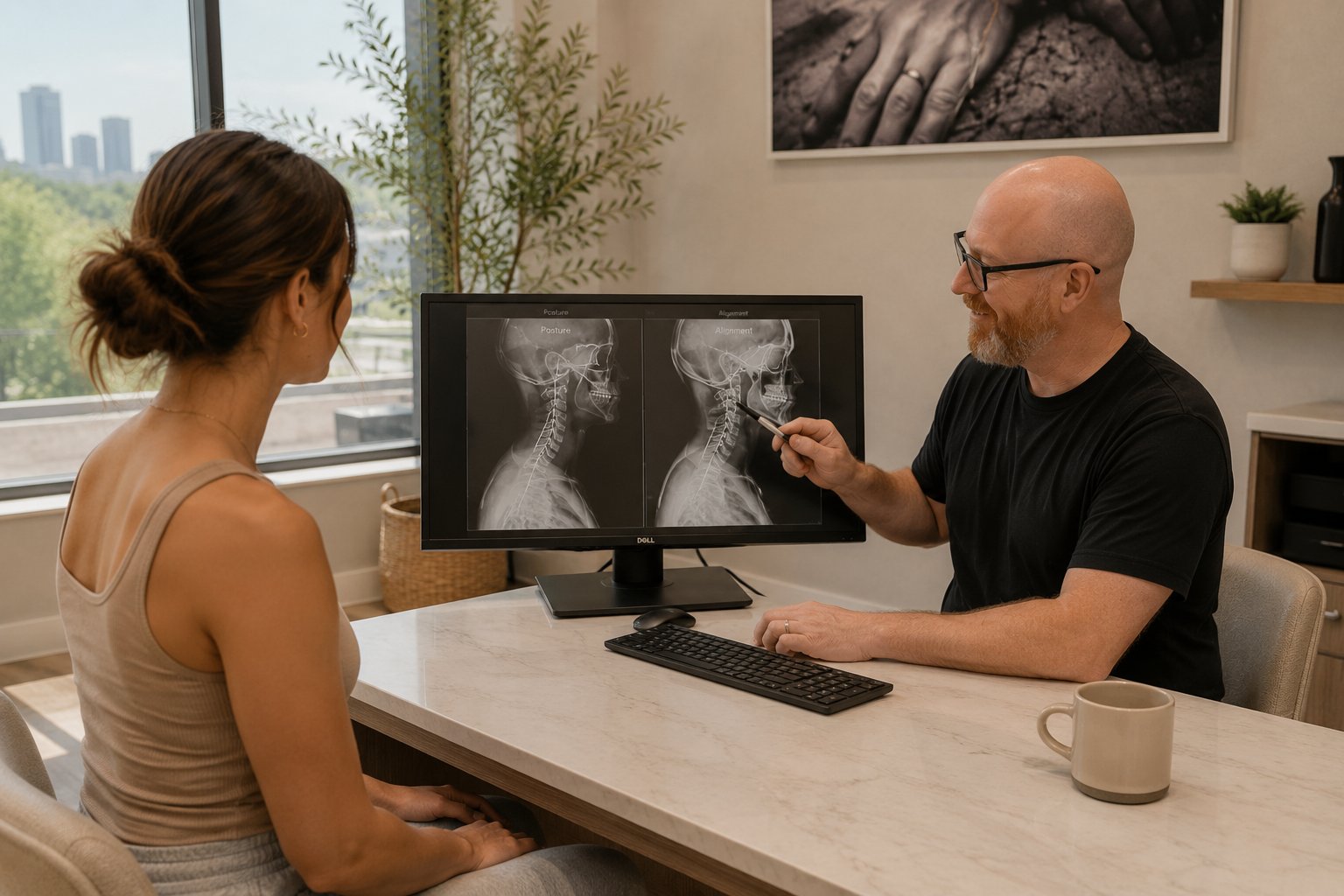
Forward Head Posture
As the head gradually shifts forward during screen use, the muscles at the base of the neck often work harder to support it.


 Schedule Headache Evaluation
Clinic information, patient education, and online scheduling for 100% Chiropractic Austin Rosedale on MendAndFlow.
100% Chiropractic Austin Rosedale 3800 N Lamar Blvd, Ste 160 Austin, TX 78756 (512) 638-8544Neck Pain & Headaches
For many Austin professionals, headaches build during computer work, ease temporarily, then return when the same neck tension, posture strain, stress, and reduced movement patterns show up again.

Quick answer
Short answer: desk work can contribute to headaches when screen use, neck tension, upper-back stiffness, stress, jaw or shoulder guarding, and reduced movement variety keep rebuilding the same pattern.
If headaches build through the workday, ease temporarily, then return, it may be worth evaluating the neck, posture, mobility, work setup, and daily habits that are contributing.

Why this matters
A lot of people assume headaches from desk work are simply part of a busy job. The pattern usually becomes clearer when headaches build during screen-heavy days, ease away from the desk, then return when the same work setup and stress load repeat.
Common scenarios include laptop work at a kitchen table, long Zoom meetings, dual monitors, phone scrolling, long Austin workdays, and end-of-day temple or base-of-skull tension.
The desk-work pattern
For many people, recurring neck tension is not random. It reflects how the body has adapted to daily stress and posture habits over time. When the neck and upper spine stay under low-level stress for hours each day, muscles often begin overworking to support posture and stabilize the head.
Many Austin professionals spend long hours at desks, in meetings, commuting, working remotely, and using laptops or phones. Over time, neck pain from computer work and headaches from sitting at a desk can become part of the same recurring pattern.
As the head gradually shifts forward during screen use, the muscles at the base of the neck often work harder to support it.

Many desk workers unconsciously elevate or tighten their shoulders throughout the day.

Sitting for long periods limits normal spinal movement and circulation.

Mental stress can show up physically in the neck, jaw, shoulders, and upper back.
The desk-work tension loop
For many desk workers, the issue is not one bad posture or one stressful day. It is the repeated loop of screen position, reduced movement, neck tension, upper-back stiffness, and jaw or shoulder guarding that can rebuild as the workday repeats.
Laptop work, meetings, dual monitors, commuting, and phone use can keep the neck and upper back in similar positions for hours.
Muscles around the neck, shoulders, jaw, and base of the skull may begin guarding as fatigue increases.
Symptoms may show up later in the day, after meetings, during stressful weeks, or after long screen sessions.
A focused assessment helps identify whether posture, mobility, muscle guarding, work habits, or another factor is contributing.
What patients notice
Most people do not schedule an evaluation after the first headache. They usually come in once they realize the pattern keeps repeating.
Many people initially assume they just need more sleep, are stressed, are working too much, need a new chair, or should stretch more before realizing how consistently posture, movement habits, and tension are contributing.
A better goal
Many people cycle between stretching, massage, pain relievers, rest, and temporary symptom reduction without ever understanding why the tension keeps returning.
For many desk workers, recurring headaches are not just isolated events. They reflect ongoing posture adaptation, muscle guarding, reduced movement variability, and accumulated stress load.
The goal of an evaluation is to understand the contributing pattern, not assume desk work is the only cause.

Short-term tools may help symptoms feel calmer without changing the pattern underneath.

Evaluation helps identify the posture, mobility, and tension patterns that keep rebuilding.
Start by understanding how neck tension, screen use, posture, mobility, and headache patterns can fit together.
What happens at your evaluation
Your visit is designed to help you understand what may be contributing to your headaches before you decide on care. Many patients do not realize how little movement variability they experience throughout the workday until symptoms become constant.
We review when headaches build, what your desk setup looks like, and what helps or aggravates symptoms.
We check mobility, posture tolerance, muscle guarding, and movement patterns that may be involved.
You leave with clear next steps and a plan that matches your findings, goals, and comfort level.
When clinically appropriate, care may begin after the exam and discussion of options.
Our approach
Our goal is not simply to chase symptoms for one visit. We want patients to better understand what may be keeping the pattern active and what options may help improve movement and comfort long term.
Care may include chiropractic care, posture and movement guidance, fascia stretch therapy, or Class IV laser therapy when clinically appropriate.
Learn more about corrective chiropractic care.

We evaluate posture, mobility, tension patterns, movement habits, and daily aggravating factors.

Gentle chiropractic care may help improve joint mobility and reduce restricted movement patterns.

We help patients understand how positioning, movement variety, and work habits may influence symptoms.

When appropriate, supportive therapies may be incorporated into a broader corrective-care approach.
When to get checked
If headaches and neck tension keep returning, worsen throughout the workday, interfere with focus or sleep, make workouts uncomfortable, create constant stiffness, or repeatedly come back after massage or stretching, it may be worth evaluating the patterns contributing to them.

Another care pathway
If your headaches, neck stiffness, or upper back tension began after a rear-end collision or sudden impact, your symptoms may fit better within our post-accident whiplash care pathway.
Yes. For many people, recurring headaches from desk work are closely connected to how the neck, shoulders, and upper back respond to long hours of sitting, screen use, and reduced movement. We commonly see desk-related headaches associated with posture strain, muscle guarding, neck stiffness, and forward-head positioning.
For many desk workers, tension gradually accumulates throughout the workday. As posture fatigue increases, the muscles supporting the neck and upper spine often begin overworking to compensate, especially during screen-heavy Central Austin workdays.
Very common among desk workers. Many recurring tension headaches and posture-related headaches are associated with stress on the neck and upper back, especially in Austin desk workers spending long periods at computers, driving, studying, or working from home.
Consider an evaluation when headaches keep returning, build during desk work, come with neck or shoulder tension, affect focus or sleep, or require repeated short-term relief. For many people, symptoms build gradually over months or years before becoming constant.
Migraine symptoms can be complex. We evaluate musculoskeletal factors that may contribute to neck tension, posture strain, reduced mobility, and headache-related discomfort. For complex, severe, or worsening migraine symptoms, patients should also consult the appropriate medical provider.
Yes. Patients often describe reduced focus, interrupted sleep, irritability, physical fatigue, and difficulty relaxing after long workdays when tension has been building for months or years. Many patients do not realize how consistently posture and reduced movement contribute to recurring headaches until their workweek starts revolving around symptoms.
Not everyone needs X-rays. Imaging is considered when your history, exam findings, trauma history, or clinical presentation suggest it may be appropriate.
Most people do not need to stop desk work entirely. The goal is usually to improve movement variety, posture tolerance, screen habits, and neck or upper back mobility so work feels less aggravating.
That is a common reason people schedule an evaluation. Stretching or massage may reduce symptoms temporarily, but recurring tension patterns rarely improve long term when daily habits never change and workday stressors keep rebuilding the same tension.
If headaches, neck pain, or upper back tension began after a rear-end collision, sudden impact, or other accident, your symptoms may fit better within a post-accident whiplash care pathway. Trauma-related headaches should be evaluated appropriately, especially if symptoms are severe, worsening, unusual, or accompanied by neurological symptoms.
Seek urgent medical care for sudden severe headaches, worsening or unusual headaches, headaches after trauma, fever-related headaches, neurological symptoms, weakness, confusion, vision changes, or symptoms that feel different from your normal pattern.
Local desk-worker headache care in Central Austin
100% Chiropractic Austin Rosedale is located at 3800 N Lamar Blvd, Ste 160, Austin, TX 78756. Patients visit us for desk headache evaluations, neck tension from computer work, posture headaches, and recurring neck-and-shoulder strain that builds through the workday.
The clinic sits between Local Foods and Westlake Dermatology facing Lamar Blvd, in the same building as Kendra Scott's HQ. We validate parking in the clinic. For garage GPS, use 3809 Medical Pkwy.
For scheduling questions, call (512) 638-8544, or get directions.

If headaches and neck tension keep returning throughout your workweek, it may be time to look more closely at the patterns contributing to them.
Our Austin clinic focuses on helping patients move better, feel better, and better understand why recurring tension keeps returning.
Last updated May 25, 2026
MendAndFlow is a healthcare-provider directory and patient-education platform owned and operated by Quake Brands LLC.
This clinic profile and its related educational and online-scheduling pages feature 100% Chiropractic Austin Rosedale.
Clinical services are provided by 100 Chiro Corona LLC d/b/a 100% Chiropractic Austin Rosedale, an independently owned and operated 100% Chiropractic franchise.
Appointment requests made through these pages are for the Austin Rosedale clinic. MendAndFlow does not provide clinical care and is not the corporate 100% Chiropractic website.
100% Chiropractic Austin Rosedale